The Strangest Thing …
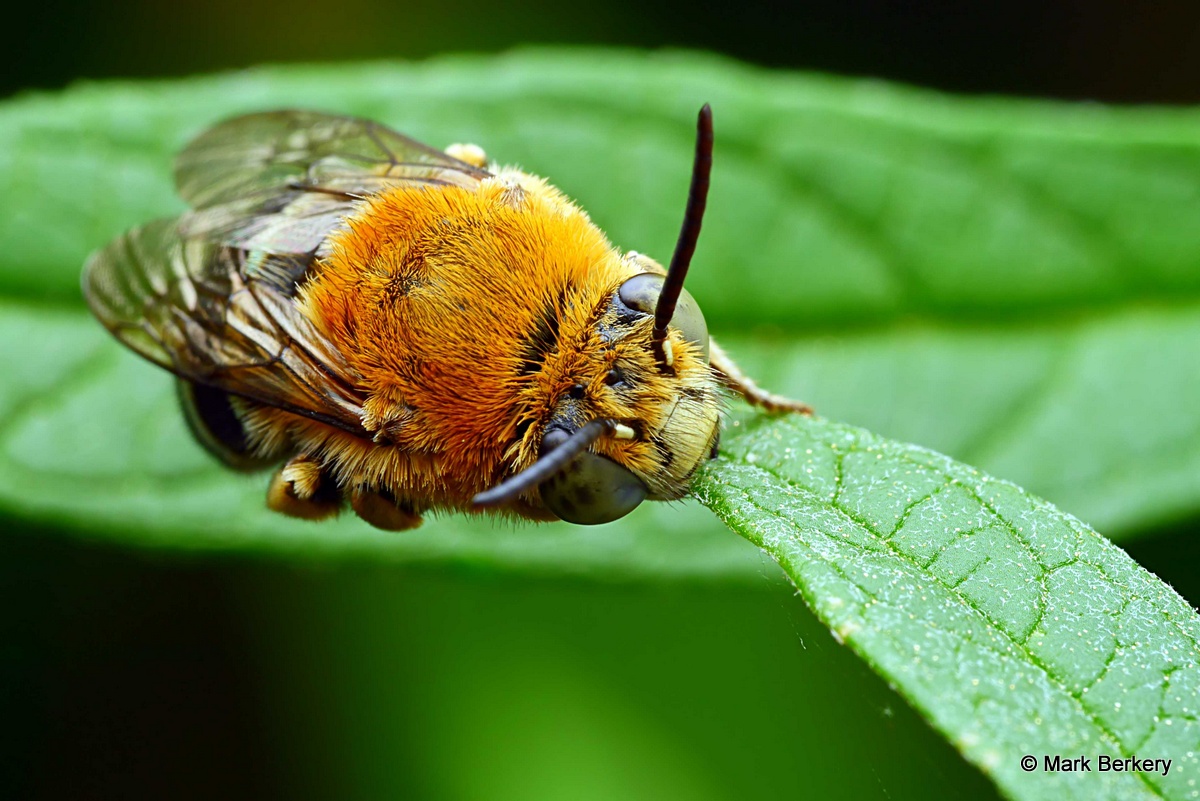
What I could get in a couple seconds, with leaf as background contrast.

Shifted positions slightly, had the time for the angle.
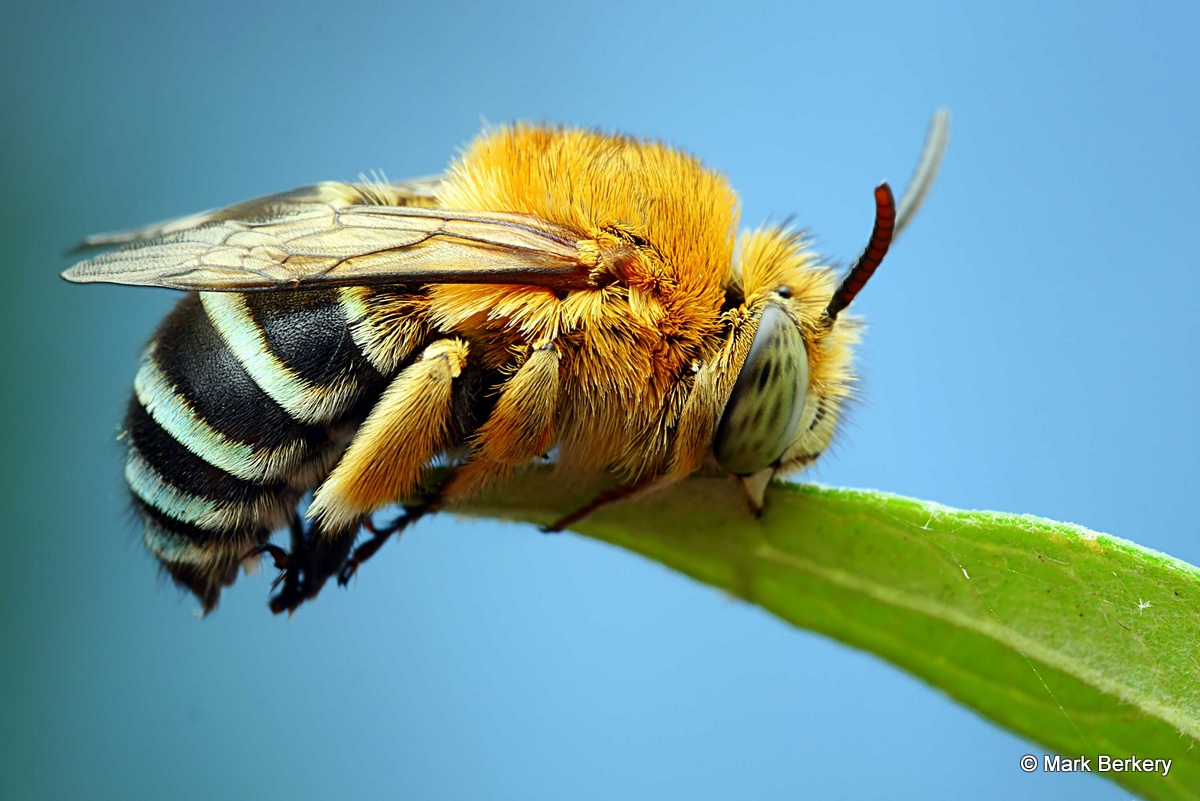
And the shot I wanted, because she stayed long enough and I didn’t shock her sensibilities.
Looking at the comings and goings in the garden recently I noticed a Blue Banded Bee behaving oddly. It isn’t unusual to see them land on a leaf’s edge, stretch their legs and preen for a second or two, or buzz the leaf’s edge or surface as they continue flying along it, but this one stopped as if it was time to sleep.
As soon as I saw it I moved in to take the shot I could get, then I moved a little for the angle I wanted. I didn’t think I’d have the time for that but she – four bands means its a female – was still in position so I went for the shot I wanted, with a little careful adjustment of elements – side on with a good clean background.
And she still didn’t move. Then, as I stood back, she began to fly but couldn’t get enough lift and fell to the grass. I went looking for her but she had disappeared into the forest at my feet and I don’t know what happened next.
A bee in this situation would normally climb the nearest grass stem and use it to launch from but I didn’t see her again. Sometimes the body just doesn’t get back up, sometimes the eye just doesn’t see.
Me? Not there yet, but looking at inevitability from my grass stem … :-)
© Mark Berkery ……. Click those pictures for a closer look
*
*
Hemispherical Living …
Do you ever wonder what it would be like to live in a hemisphere?
Nor do I. But since I brought it up let’s have a look.

The Thinking Beetle.
Hmmm! That feels … truncated, like half a sphere would.
Maybe it’s spherical living that’s over-rated, living in a head for instance.

Ooh, what’s that?
What’s it like living in a spherical head then?
Well, first of all, can I actually fit in a head I can imagine? I don’t think so.

Oh, never mind …
And there’s the catch, thinking of living in or as anything is very limiting.
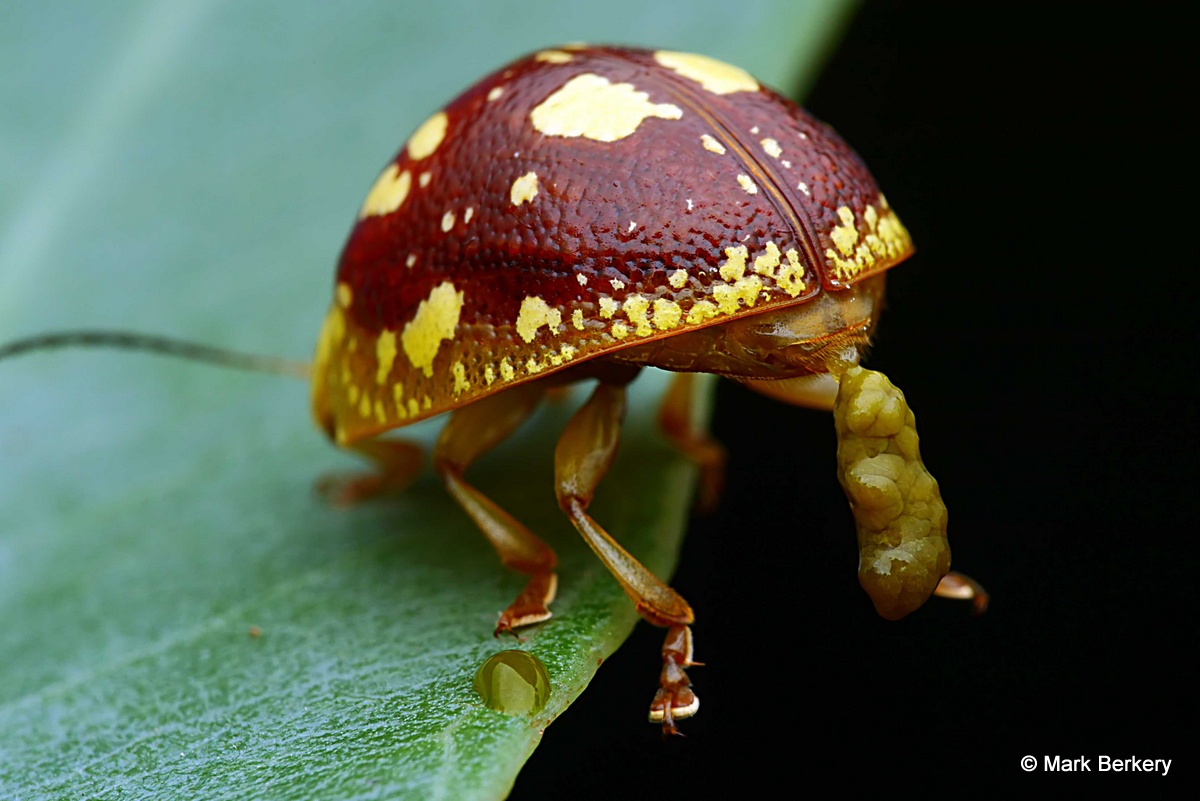
Straight down to business.
Thinking is limiting …
*
Macro Nature Photography …
… the why, the where and the how.

Looking in the mirror.
Historically, time in nature has been prescribed for the convalescence of body, mind and spirit. There is a simple reason for this. There is little for the thinking mind to go to work on in nature. So being in nature is, fundamentally, a holiday from the thinking mind.
This is how I started doing macro nature photography. I was used to a very busy and stressful worldly life and it wasn’t enough, or it was too much. It was making me ill and I needed to do something about it, to mitigate the detrimental effects of ‘busy’ living, and I saw the practical value of spending time in nature.
For it to work best it helps to know something of the process.

No, not that process.
The process is simplicity itself. If being in nature is in fact beneficial to the whole being what is it about it that makes it work? Attention, what you consciously focus your attention on.
If you go into nature and take your worries with you, think about what stresses you, you aren’t really in nature at all, you are still in the world of busyness and stress. When we go into nature we tend to do this thinking subconsciously, habitually, and the need is to break the habit with a conscious effort.
It’s only an effort to begin with. And after a short while, knowing what you are doing, it becomes a pleasure to simply hear the bird call, see the greenery ever shifting in the breeze, feel the wind in your hair, the sensation of earth under foot, sky overhead.
So, you see the difference? Either your attention is in the world of thinking, or it is in the world of the senses. Two distinct worlds to attend to, if you take the time to look.
And as with anything else the more time you give to it the more it gives back, the more real the effects of it become.
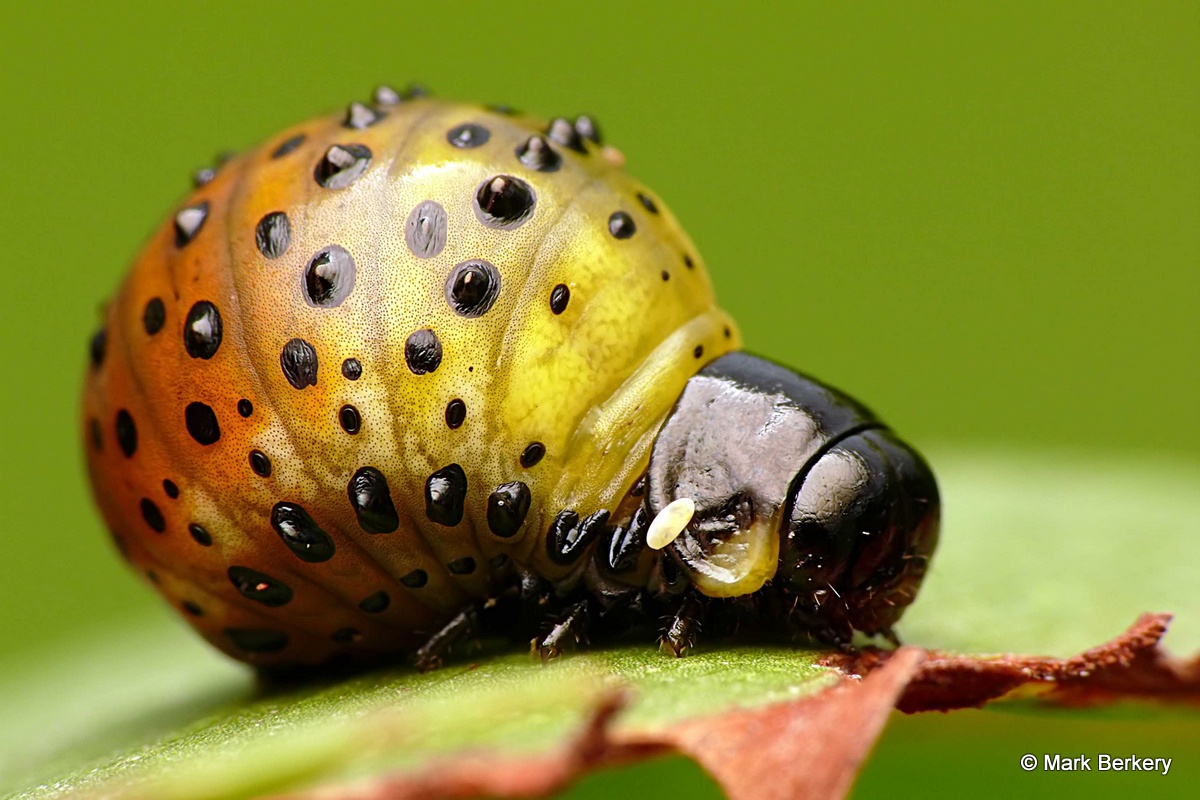
The odd man out.
There are many ways to give time to being in nature and once you get the idea of the difference between thinking and the senses it matters little what way you take. What works for me is macro nature photography.
These days almost everybody in the West has a camera of one kind or another and with little adjustment almost any camera can be used to take unique and interesting macro photographs. Almost every mobile phone has a camera and you can even buy attachment lenses for them now.
And the world of macro is at your feet, you don’t have to travel anywhere to see the amazing colours and designs of nature. Nature can be sensed in a single leaf, or in the wondrous living insects that can be found and photographed in any garden.
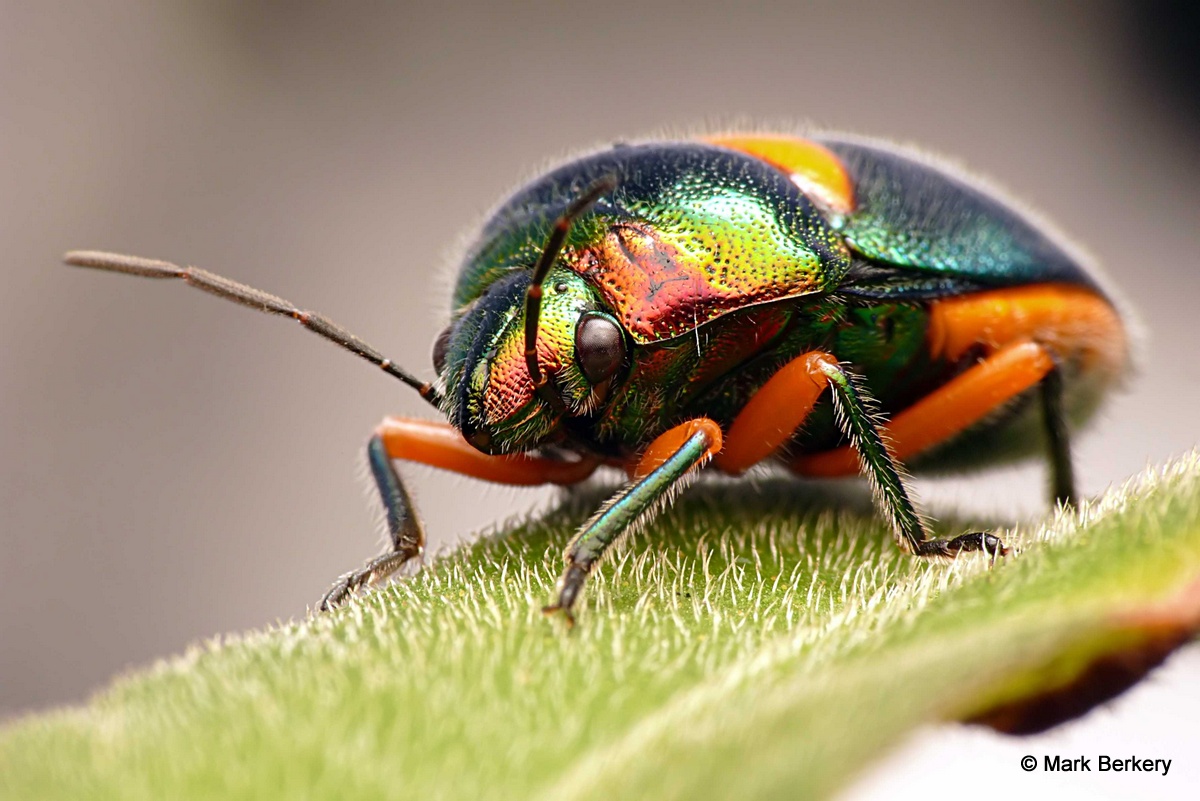
Against a darkening sky.
Now you know why to do it and where to do it, all that remains is the how.
It will take some practise to get pictures like mine but if you give it time and make the effort the attention you give it will be rewarded with amazing macro pictures.
You’ve got a camera, any camera, and it probably has a macro function. Read the manual or go online and find what you need. You will probably find others already use or have used the same camera for macro.
If your camera doesn’t have a macro function you can buy a cheap macro filter at a camera store or online to fit the filter thread of your lens.
Your camera also usually has a built in flash which can be used to good effect, to keep the image sharp and bright. Diffusion, to spread the flash light and make it less harsh, can be a piece of paper towelling held on top of the lens with a rubber band.
There is usually a manual function on a camera whereby you can set the shutter speed (SS) and the aperture (A). Use it to set SS at 1/160sec and faster, and A at f8 to f16. With flash set at on you are ready to go. Or just go to macro mode.
One thing important to know when taking macro photos is your camera will best focus at certain distances. It’s not the same for every camera and you can find this out either in the manual or with a little research – by asking questions, usually at an online photography forum.

Jolly fellow.
The approach to acquiring photos of insects is necessarily one of respect. You are the king or queen of your garden and if you fail to respect the sensibilities of your subjects they will revolt, as every ruler down through the ages has learned to their detriment.
If you don’t want those beautiful insects to run away and hide or attack you show them respect. Remember, they are survivors just like you so they will act and react according to the various stimuli of their environment.
You are one major source of stimuli in their environment and the trick is to not stimulate them into any action or reaction, unless you really know your subject and it serves the purpose without causing harm.
Get to know your subjects and their needs and habits and you will get close enough for a picture – not all insects have the same sensitivities. It takes time and patience and eventually, through careful observation, the insects will tell you all you need to know about them.

In the coneflower.
So you want to take a picture of the beetle in the flower? Well, I suggest you practise on the flower first. But let’s say you’ve done that and you’re ready for the challenge of a mobile subject, albeit slow moving or momentarily stationary.
The first thing to do is look. Is the creature too fast or is it moving and stopping. Is it stopping for a few seconds at a time, more or less. Is it a situation where you can brace the camera for a steady shot at the right distance. If it is you have an opportunity. As soon as it stops or looks occupied with something move in close. Set yourself up for the shot.
The key here is when an insect is focussed on something, anything, eating, mating or just resting they can be so absorbed they don’t notice you moving in their view and will sometimes even tolerate some disturbance. And don’t doubt it, they can see you and will notice you and act or react if you don’t approach carefully.
If at first you don’t succeed don’t lose heart. Nobody got to be expert overnight, persistence with the right approach and technique will be rewarding.
It just takes time and practise in the garden.
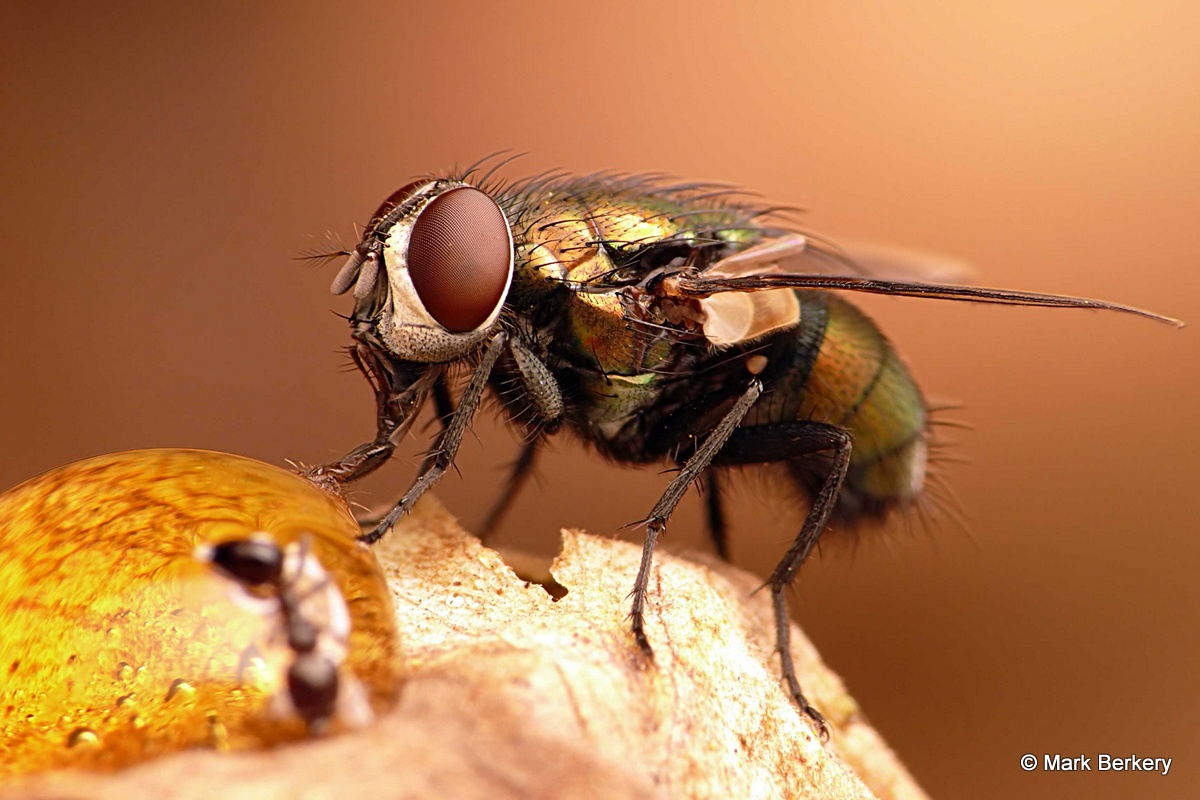
Sucker for a drop of honey.
And there you have it, the why, the where and the how. Of course there is more to it, there always is.
If you want to see the long version have a look at my Macro Illustrated page and scroll down.
*
Black Wasp
Edited 13/12/16 – for clarity only. Text and pictures – from when I started macro – remain as then, 14/4/08.


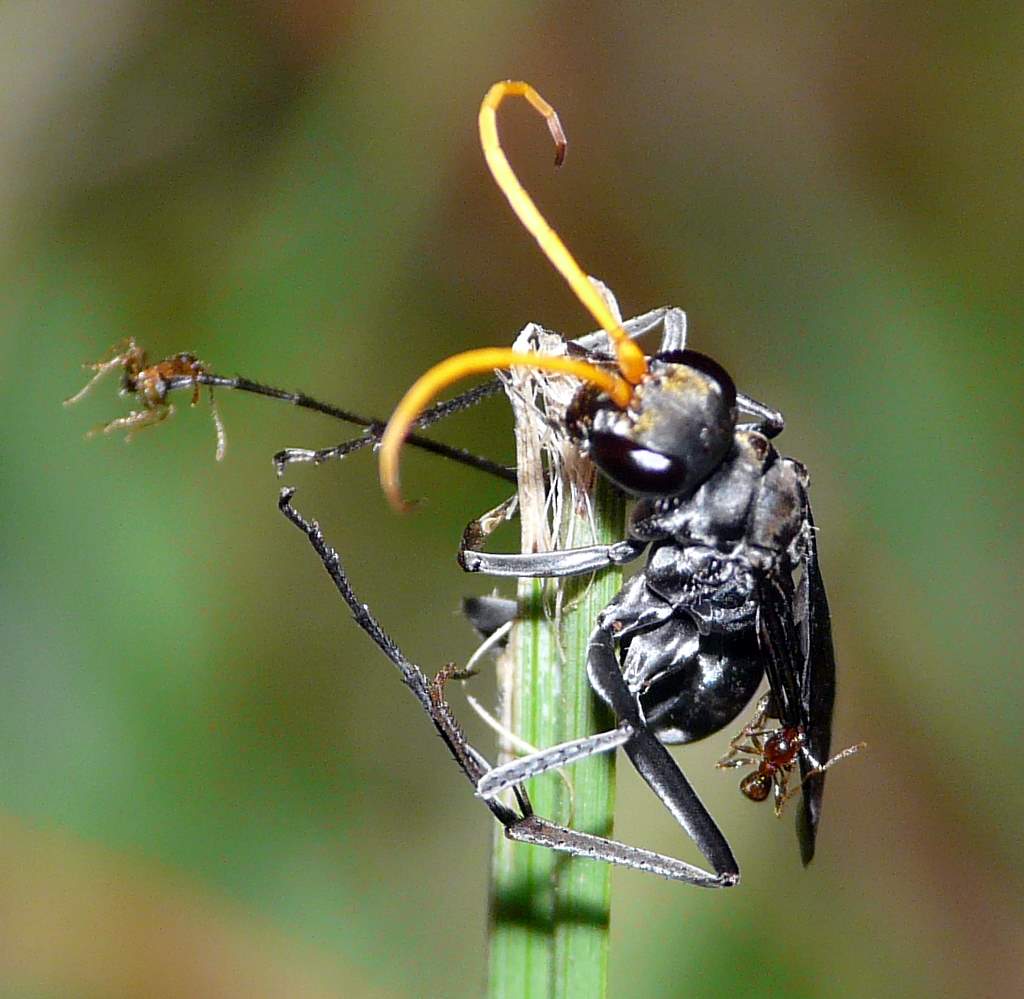

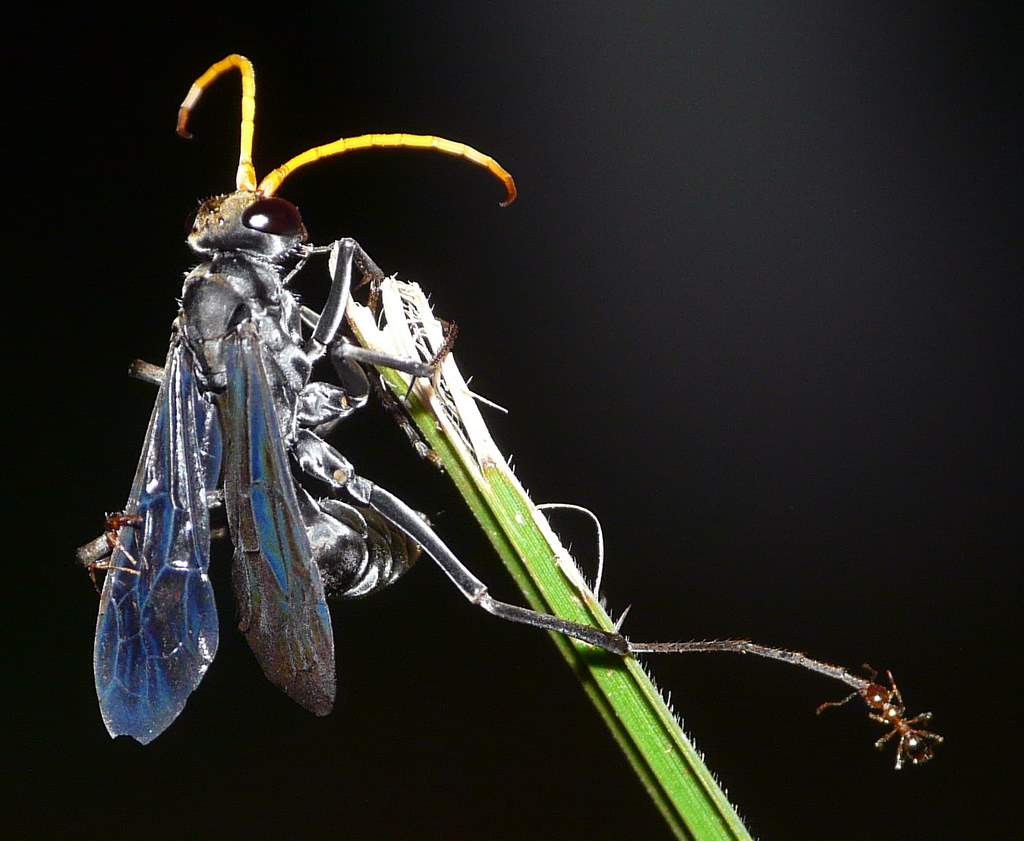
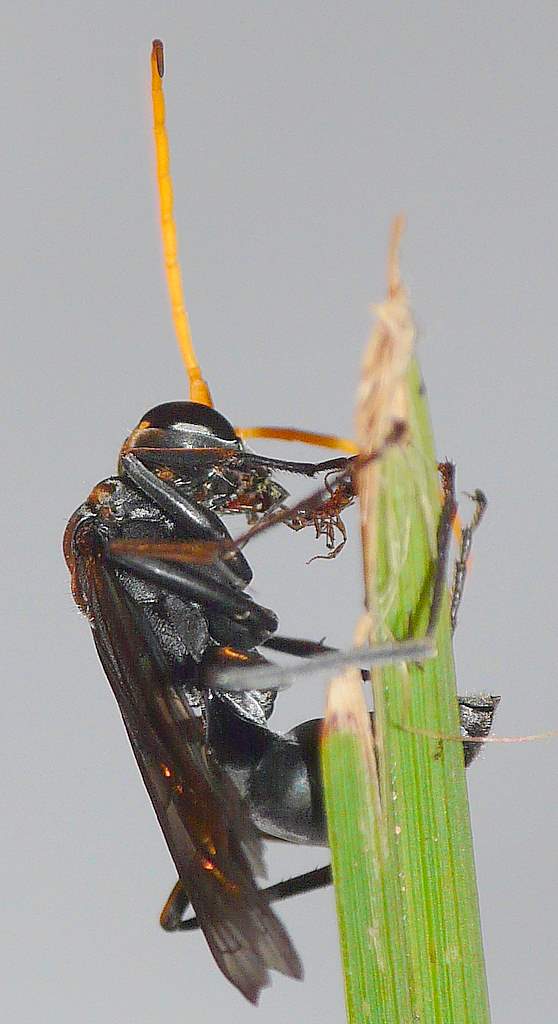
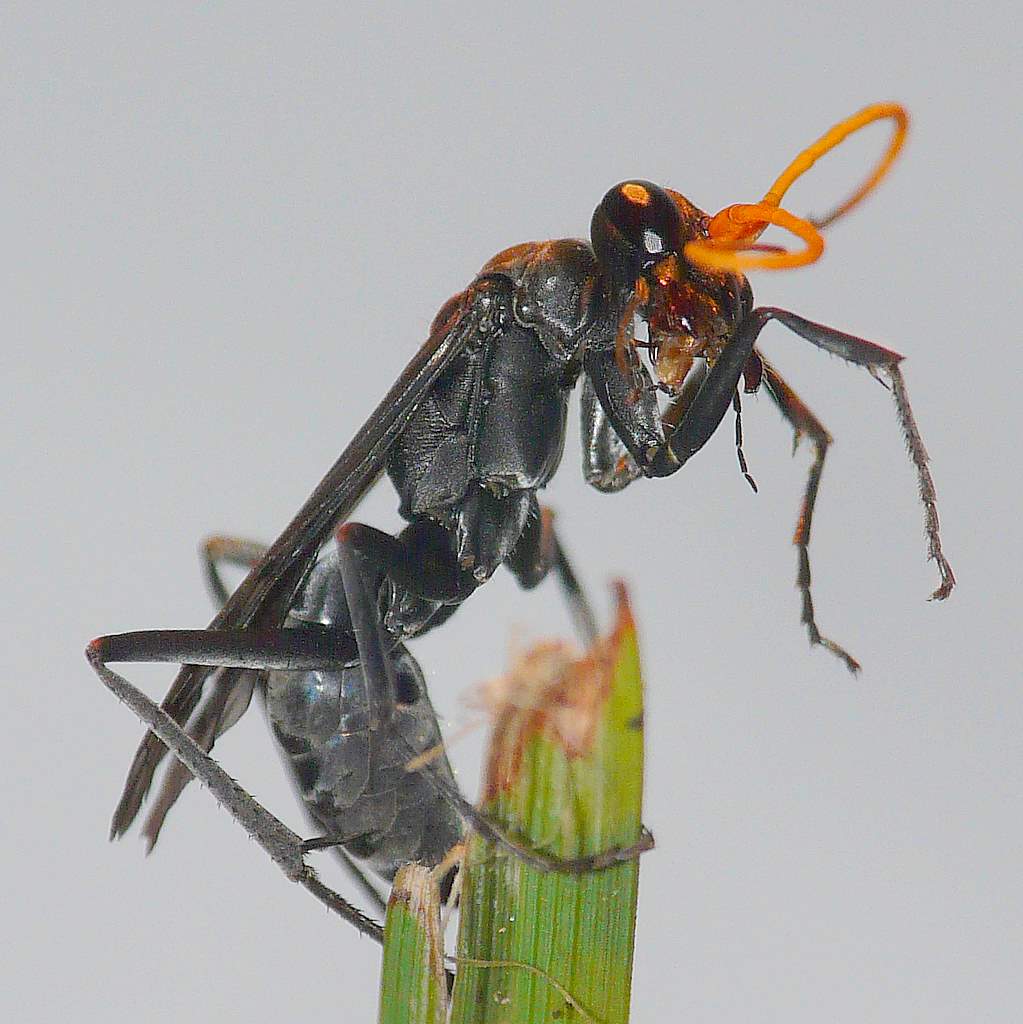


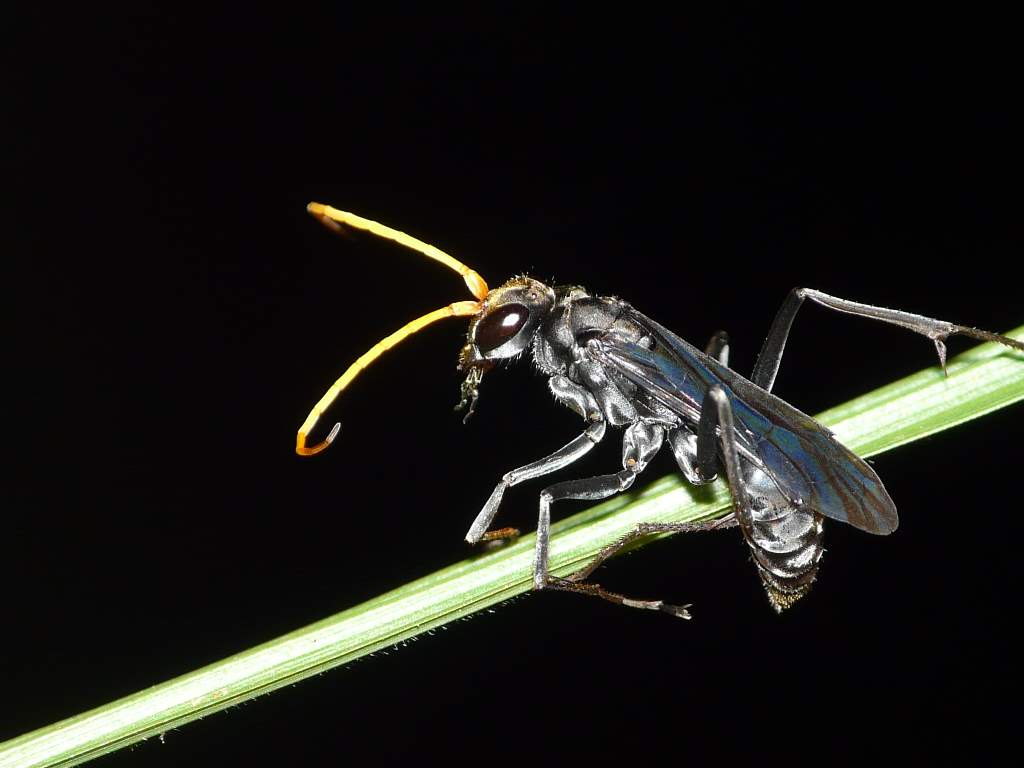
I noticed a jet black insect with two bright yellow antennae crawling through the grass in a hurry at dusk yesterday. A wasp, looked like. About three centimetres long. I bent to have a look and arrived at ground level just as the creature started to make its way up a blade of grass.
The grass was only six inches long but it was off the ground and relatively safe. The wasp seemed agitated and I thought it was out of place for it to be in the open as the sun was going down. So I went to get the camera for a better look.
On close inspection it was obvious what was the matter. An ant had a grip of the side of one wing. Chances were it couldn’t fly with the ant’s weight throwing it off balance and ruining its aerodynamics. And it was getting dark.
The ant had only one thing in mind. I have left bits of fruit out for these ants, to get a closer look. But they are not interested. They prefer meat.
*A word about these ants. They are only tiny, maybe three or four millimetres long, but they have Herculean strength. I have seen just a few of them pulling the body of a big fly a hundred times their own weight along the ground, relentlessly. They are everywhere around the house and I have come to respect them as the cleaners. They tidy up everything they can use, anything dead – or alive, moths wings left over from the frogs dinner, anything. I have even seen one take on a jumping spider – and lose. But they are numerous, untiring and capable of phenomenal effort.
As I started snapping I noticed the ant on the wing wasn’t the only problem. There was another one attached to one of the black wasp’s feet. The wasp was swinging and shaking its leg while keeping it at a distance from its body.
If a second ant were to get on its other wing it would be a goner for sure. How did the ants get on it in the first place? The wasp must have stumbled into a stream or swarm of ants for two to get such a hold of it. It did well to get away with only the two hangers on.
At the top of this blade of grass, for the next few hours, I witnessed a mighty struggle indeed. A life and death struggle. The wasp couldn’t turn its head enough to get at the ant on its wing but this was the greatest threat so it focussed its attention here while keeping the other at a distance.
Without flight the wasp was surely dead. I watched it perform all sorts of manoeuvres to try to dislodge the ant but for a long time nothing worked. It turned every way around the blade of grass and, eventually, by design or fortune, the ant was dislodged. I didn’t see it go.
But I did see it being eaten, in pix six, seven and eight. Where the wasp is standing up on the tip of the grass, an almost triumphant stance. But the fight wasn’t over, in fact it raged on for ages. There was still the one on the leg which couldn’t be ignored.
He wasn’t going away just because he was on his own. I shot it all from every angle trying to keep it all in focus, in the dark, by the light of a dying torch. I tried different things to highlight the action but the fact is I couldn’t see what I was getting until later.
Out of a couple hundred shots I got a few reasonably good ones to illustrate the event. I think so. In pix nine and ten it is obvious the wasp won out and in the morning there was no sign of it. I assume it flew away on its own business.
In the end the ants had taken on more than they could handle. At least one of them paid with his life. The one on the wing. I suspect the other went the same way.
The little ants don’t give up and run away. The wasp was persistent, and stronger in the end.


 Nature's Place
30 comments