Macro Nature Photography …
… the why, the where and the how.

Looking in the mirror.
Historically, time in nature has been prescribed for the convalescence of body, mind and spirit. There is a simple reason for this. There is little for the thinking mind to go to work on in nature. So being in nature is, fundamentally, a holiday from the thinking mind.
This is how I started doing macro nature photography. I was used to a very busy and stressful worldly life and it wasn’t enough, or it was too much. It was making me ill and I needed to do something about it, to mitigate the detrimental effects of ‘busy’ living, and I saw the practical value of spending time in nature.
For it to work best it helps to know something of the process.

No, not that process.
The process is simplicity itself. If being in nature is in fact beneficial to the whole being what is it about it that makes it work? Attention, what you consciously focus your attention on.
If you go into nature and take your worries with you, think about what stresses you, you aren’t really in nature at all, you are still in the world of busyness and stress. When we go into nature we tend to do this thinking subconsciously, habitually, and the need is to break the habit with a conscious effort.
It’s only an effort to begin with. And after a short while, knowing what you are doing, it becomes a pleasure to simply hear the bird call, see the greenery ever shifting in the breeze, feel the wind in your hair, the sensation of earth under foot, sky overhead.
So, you see the difference? Either your attention is in the world of thinking, or it is in the world of the senses. Two distinct worlds to attend to, if you take the time to look.
And as with anything else the more time you give to it the more it gives back, the more real the effects of it become.
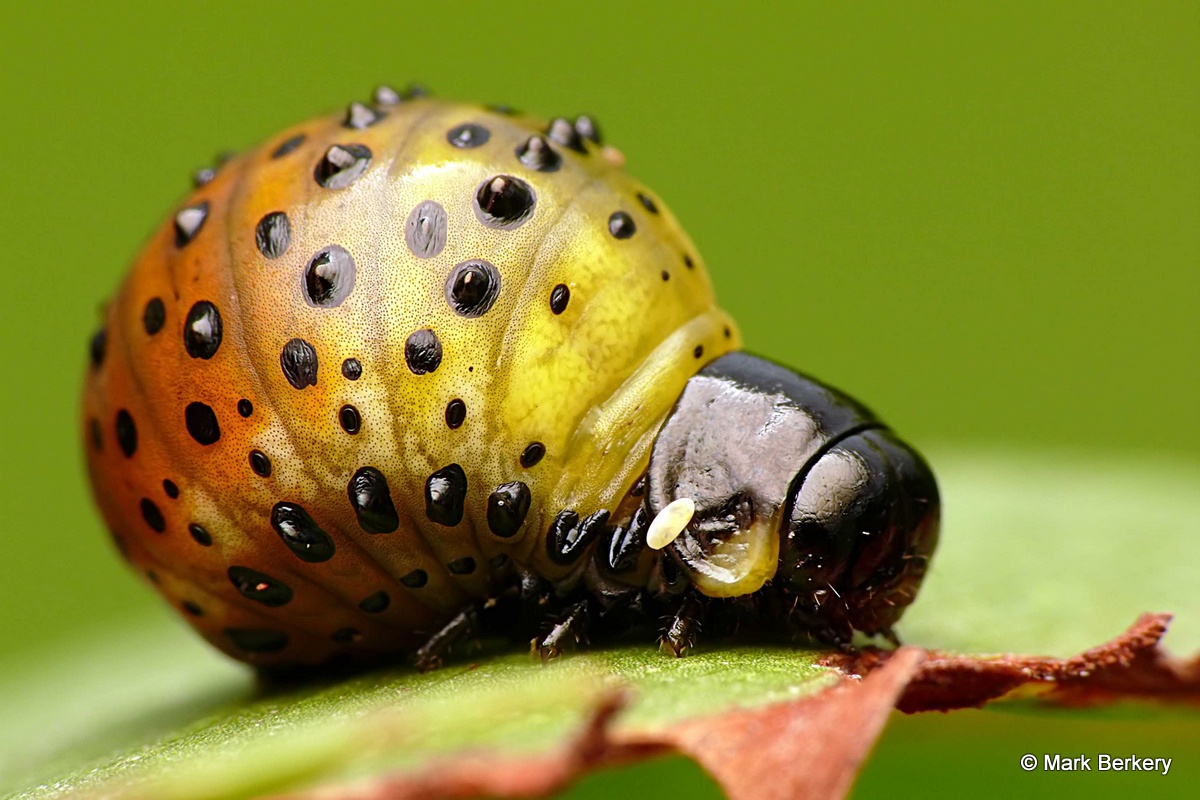
The odd man out.
There are many ways to give time to being in nature and once you get the idea of the difference between thinking and the senses it matters little what way you take. What works for me is macro nature photography.
These days almost everybody in the West has a camera of one kind or another and with little adjustment almost any camera can be used to take unique and interesting macro photographs. Almost every mobile phone has a camera and you can even buy attachment lenses for them now.
And the world of macro is at your feet, you don’t have to travel anywhere to see the amazing colours and designs of nature. Nature can be sensed in a single leaf, or in the wondrous living insects that can be found and photographed in any garden.
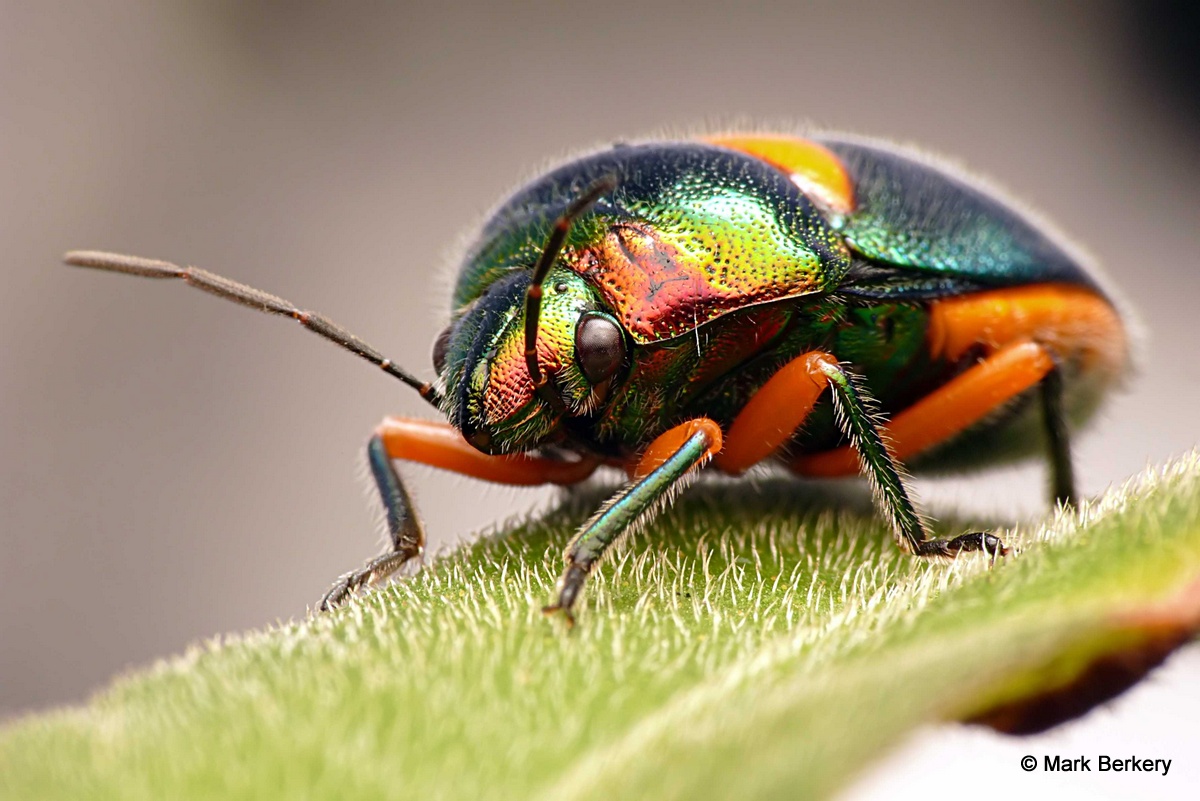
Against a darkening sky.
Now you know why to do it and where to do it, all that remains is the how.
It will take some practise to get pictures like mine but if you give it time and make the effort the attention you give it will be rewarded with amazing macro pictures.
You’ve got a camera, any camera, and it probably has a macro function. Read the manual or go online and find what you need. You will probably find others already use or have used the same camera for macro.
If your camera doesn’t have a macro function you can buy a cheap macro filter at a camera store or online to fit the filter thread of your lens.
Your camera also usually has a built in flash which can be used to good effect, to keep the image sharp and bright. Diffusion, to spread the flash light and make it less harsh, can be a piece of paper towelling held on top of the lens with a rubber band.
There is usually a manual function on a camera whereby you can set the shutter speed (SS) and the aperture (A). Use it to set SS at 1/160sec and faster, and A at f8 to f16. With flash set at on you are ready to go. Or just go to macro mode.
One thing important to know when taking macro photos is your camera will best focus at certain distances. It’s not the same for every camera and you can find this out either in the manual or with a little research – by asking questions, usually at an online photography forum.

Jolly fellow.
The approach to acquiring photos of insects is necessarily one of respect. You are the king or queen of your garden and if you fail to respect the sensibilities of your subjects they will revolt, as every ruler down through the ages has learned to their detriment.
If you don’t want those beautiful insects to run away and hide or attack you show them respect. Remember, they are survivors just like you so they will act and react according to the various stimuli of their environment.
You are one major source of stimuli in their environment and the trick is to not stimulate them into any action or reaction, unless you really know your subject and it serves the purpose without causing harm.
Get to know your subjects and their needs and habits and you will get close enough for a picture – not all insects have the same sensitivities. It takes time and patience and eventually, through careful observation, the insects will tell you all you need to know about them.

In the coneflower.
So you want to take a picture of the beetle in the flower? Well, I suggest you practise on the flower first. But let’s say you’ve done that and you’re ready for the challenge of a mobile subject, albeit slow moving or momentarily stationary.
The first thing to do is look. Is the creature too fast or is it moving and stopping. Is it stopping for a few seconds at a time, more or less. Is it a situation where you can brace the camera for a steady shot at the right distance. If it is you have an opportunity. As soon as it stops or looks occupied with something move in close. Set yourself up for the shot.
The key here is when an insect is focussed on something, anything, eating, mating or just resting they can be so absorbed they don’t notice you moving in their view and will sometimes even tolerate some disturbance. And don’t doubt it, they can see you and will notice you and act or react if you don’t approach carefully.
If at first you don’t succeed don’t lose heart. Nobody got to be expert overnight, persistence with the right approach and technique will be rewarding.
It just takes time and practise in the garden.
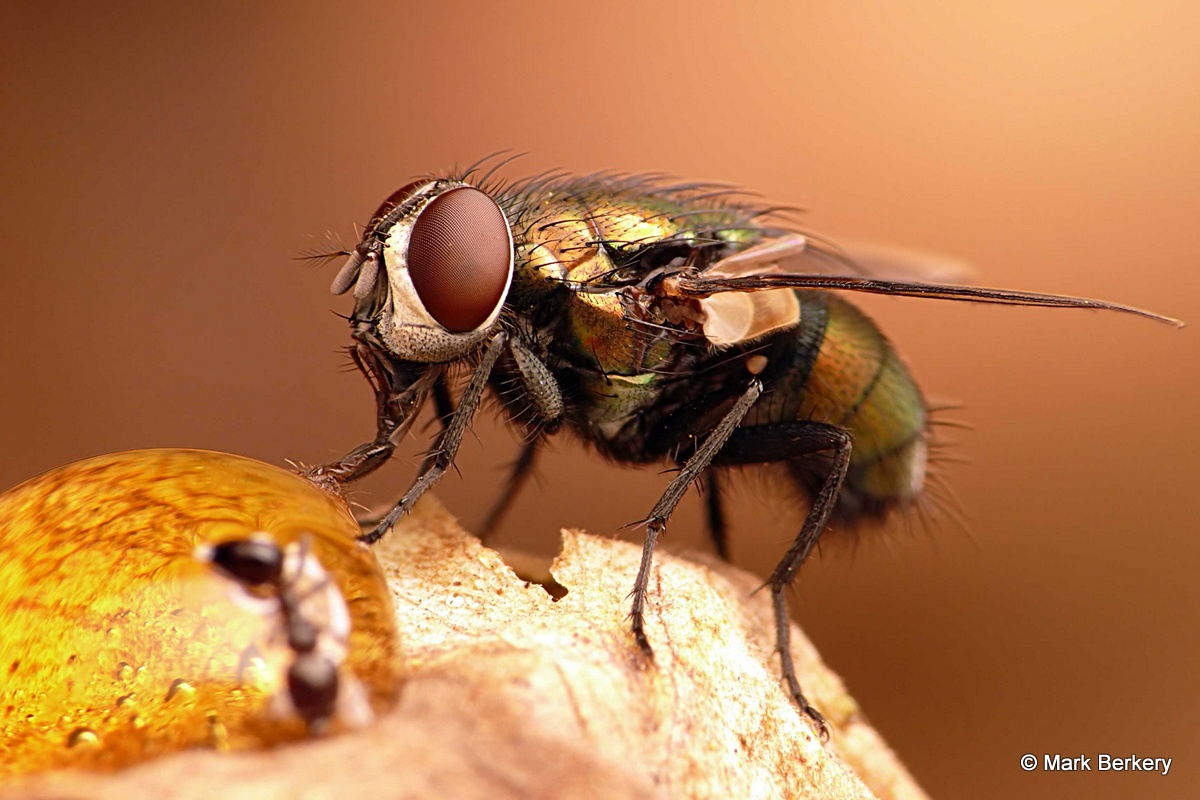
Sucker for a drop of honey.
And there you have it, the why, the where and the how. Of course there is more to it, there always is.
If you want to see the long version have a look at my Macro Illustrated page and scroll down.
*
Rare Visitor …
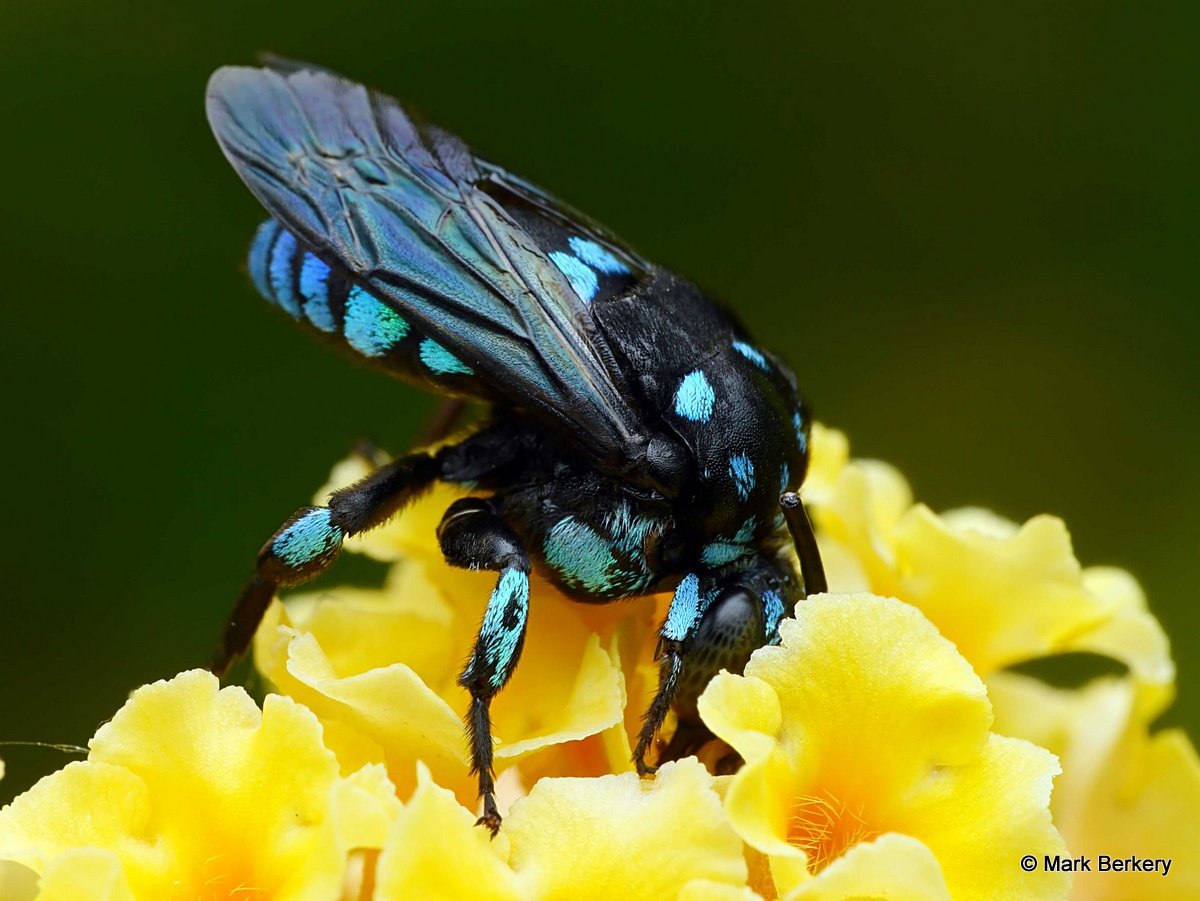
… to my garden. The Neon Cuckoo Bee lays her egg in a Blue Banded Bee’s nest and the BBB provisions it for the NCB. This may account for an apparently hostile relationship when both approach the same roost at sundown, maybe not. Maybe they just squabble over top spot on the grass stem, as the BBB seem to do amongst themselves.
Either way she is a real beauty, black and blue set against the yellow flowers. No complete body shots, she was too busy feasting, but nevertheless a treat for the observer that sees, that resonates in a place in the uncontaminated psyche where nature comes from.
A pleasure to me.
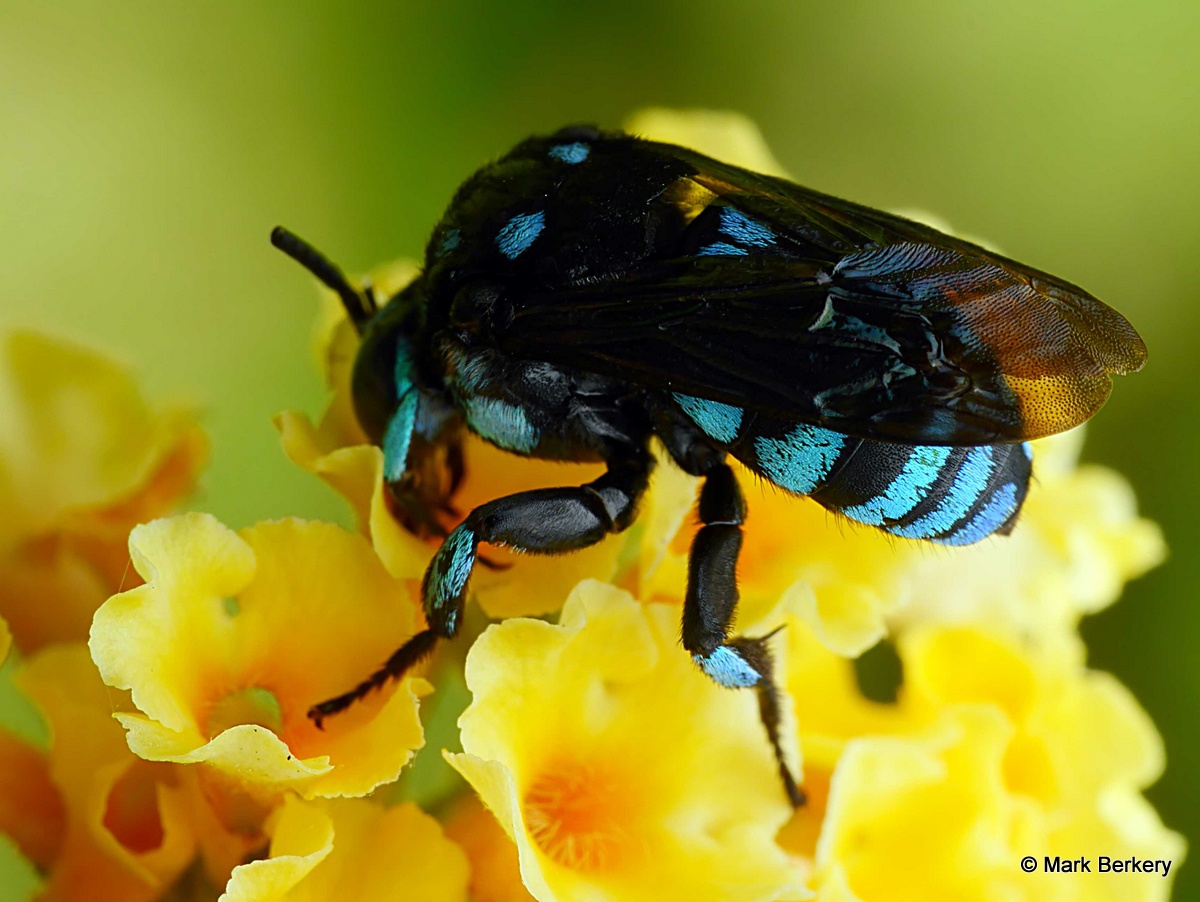
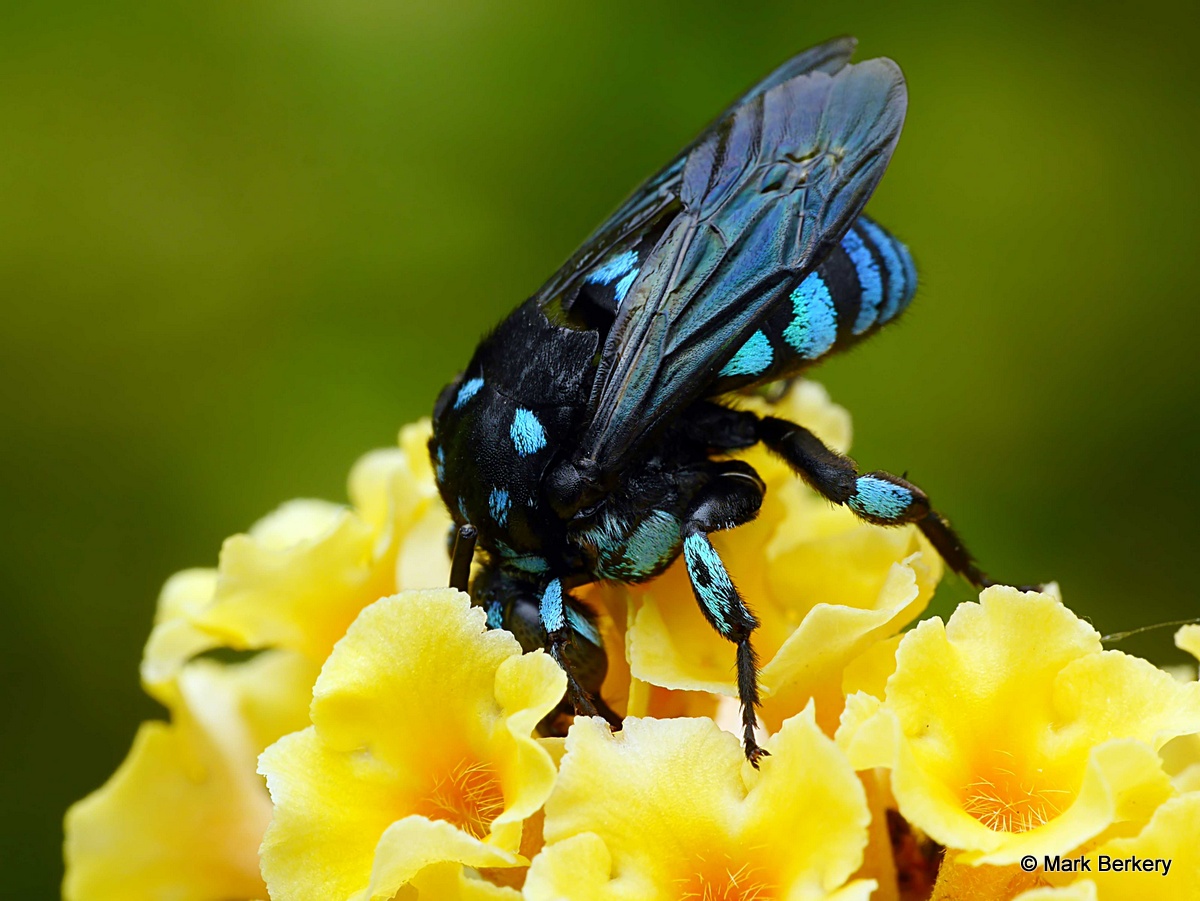
© Mark Berkery ……. Click those pictures for a closer look
*
*
The Three Hombres …
The Three Hombres … A post here wouldn’t be complete without pictures.
Some of the latest visitors to the garden, a trio of beetles on the pink Crucifix Orchid. They aren’t found anywhere else in the garden, that I can reach.
It just shows, there is a place and time for everything. In the garden, or the field, there are tides of things, living and dead, the coming and the going of the forms of life.
Within the tides there are eddies and currents, splashes and sprays. It’s a wonderful thing, not knowing what’s coming on the next wave.
Out of the mystery she flows …


© Mark Berkery ……. Click those pictures for a closer look
*
*
Gypsy Spider …
She’s back … At the beginning of September this year I went out into the garden to have a look around, it was near enough 1.00am. There hadn’t been much to shoot and it occurred to me to take the camera with me, not unusual that.
And there she was, the first place I looked, sitting in meditative pose atop a small daisy bud. A tiny ghost spider, bright against the dark of the night.

Since then she has come and gone across the garden, from daisy to butterfly bush to sunflower, chia, coneflower and round again. Through torrential rain, baking sun and howling winds …

Every time I see her she has grown, and every now and then I come across pockets of young crab spiders, some hers I suspect. Some numbers dead in a tray under one of the bee hotels.

Currently she is resident on the yellow butterfly bush, one leg missing and bolder than ever – age and experience showing. She lets me get very close now without much sign of alarm or resistance.

I trust she lives a while longer, fulfilling her purpose of nature’s intelligent instinctive desire, albeit unconsciously, and we will meet again in the garden.

All the good is in the garden, or the garden is all the good, an other time and place … inside.
© Mark Berkery ……. Click a picture for a closer look
*
*
What A Feast …


… the garden is. In more ways than one, I know.
To the senses a delight, of colour and form, scent and texture. Then just a little closer and …
… nature knows no pity, no sentimentality, just survival and reproduction. Only the fittest, the fastest, the craftiest endure.
And the wild formless intelligence behind it cannot be denied, while no thing, no body, lasts longer than its time.
I had a dream … that turned out to be a nightmare.
Now I don’t dream any more.
And the dream goes on.
© Mark Berkery ……. Click a picture for a closer look
*
*
Noble Visitors …


It’s another record year, never been 2015 before, as far as we are aware.
And in the garden it’s been another record, but who’s counting … I can’t help noticing the increase in variety and numbers of insect visitors, especially now the butterfly bushes are flowering and a few years work with the soil is bearing fruit.
It is said the Stag is a noble beast – I remember that from somewhere. Maybe it comes from the old English kings practise of hunting them, they had to be noble for kings to hunt them …
But really, kings are just ordinary men dressed up. Every body is of noble blood, all god – whatever that is – made. And the antlered beetle is no exception.
All god made things, and all things god made. To exclude one is to invite conflict to the mind.
Try maintaining a prejudice, a psychological position, without some conflict appearing.
As within, so without. And nothing is absolute, both ways …
© Mark Berkery ……. Click a picture for a closer look
*
*
Raiders On The Tom’s …


They’re back, the dreaded fruit fly – dreaded by some because they destroy the harvest. I see them as a photo opportunity, since I don’t expect so am not disappointed.
I have a few tomato plants at different locations in the garden and at just one site something has been taking big bites out of some growing fruit and opening the way for so many others to feast.
This years garden is burgeoning beyond bounds. Plants overgrowing others to their apparent detriment. I just do a little pruning, dead-heading, and trust it works out for the best. The insects are loving it.
And oddly – not for me but against the usual thinking, I see the insects as a good sign, all is well in my garden. Because that’s nature and my garden is me ‘out there’. As within so …
I find if I let what must be alone ‘enough’, inside and out, it doesn’t take more than its share of the available space and things are in balance, not too much or too little of anything.
Equilibrium, who could ask for more?
I know, I know …
© Mark Berkery ……. Click a picture for a closer look
*
*
She …

She lies in wait, unmoving … threads on the blue to tell and trap or trip.

Capture … seen first from below, or upside down.

From above … after a little manipulation, careful not to alarm her.

A bountiful day … for the spider queen.

The discarded husk, falls from the blue, form without much life, emptied of nourishment.
… waits by the flower for her love, a need of food to sustain her, in this time of reproduction, instinctively – without self-conscious calculation.
The blue flower embroidered with her silk, the better to do her job of capture and eat, to feed the young, potential in her.
Red Nasturtium papers the walls of her minds eye, bees and flies the action in her unoccupied space.
Perpetual nature, incomplete in mortal form, knowledge to the seeing eye.
Thank you for the perfect little things.
© Mark Berkery ……. Click a picture for a closer look
*
*
Pretty On Pink

A Green Shield Bug flits from place to place around the garden. If it doesn’t find what it wants in one place off it goes to another. But what does a bug want? Food, shelter and a mate, what else …
It doesn’t know to want anything it doesn’t need. Could it possibly just enjoy the colour in the sunshine, playing in the garden. As many other garden dwellers can be seen or seem to do.
Is there any conscious self awareness in a bug, or is it an instinctive organic robot. Maybe a messenger of a greater intelligence, the earth perhaps.
And anything born has the potential of its mother, and more.
Let’s not dismiss the little things.
© Mark Berkery ……. Click a picture for a closer look
*
*


 Nature's Place
36 comments